Blind
Web-based assistants cannot reach live logs or private codebases.
Incident Response & Intelligence System
My team and I built an autonomous multi-agent system to support IT incident analysis, root-cause investigation, and post-incident documentation.
Project moments
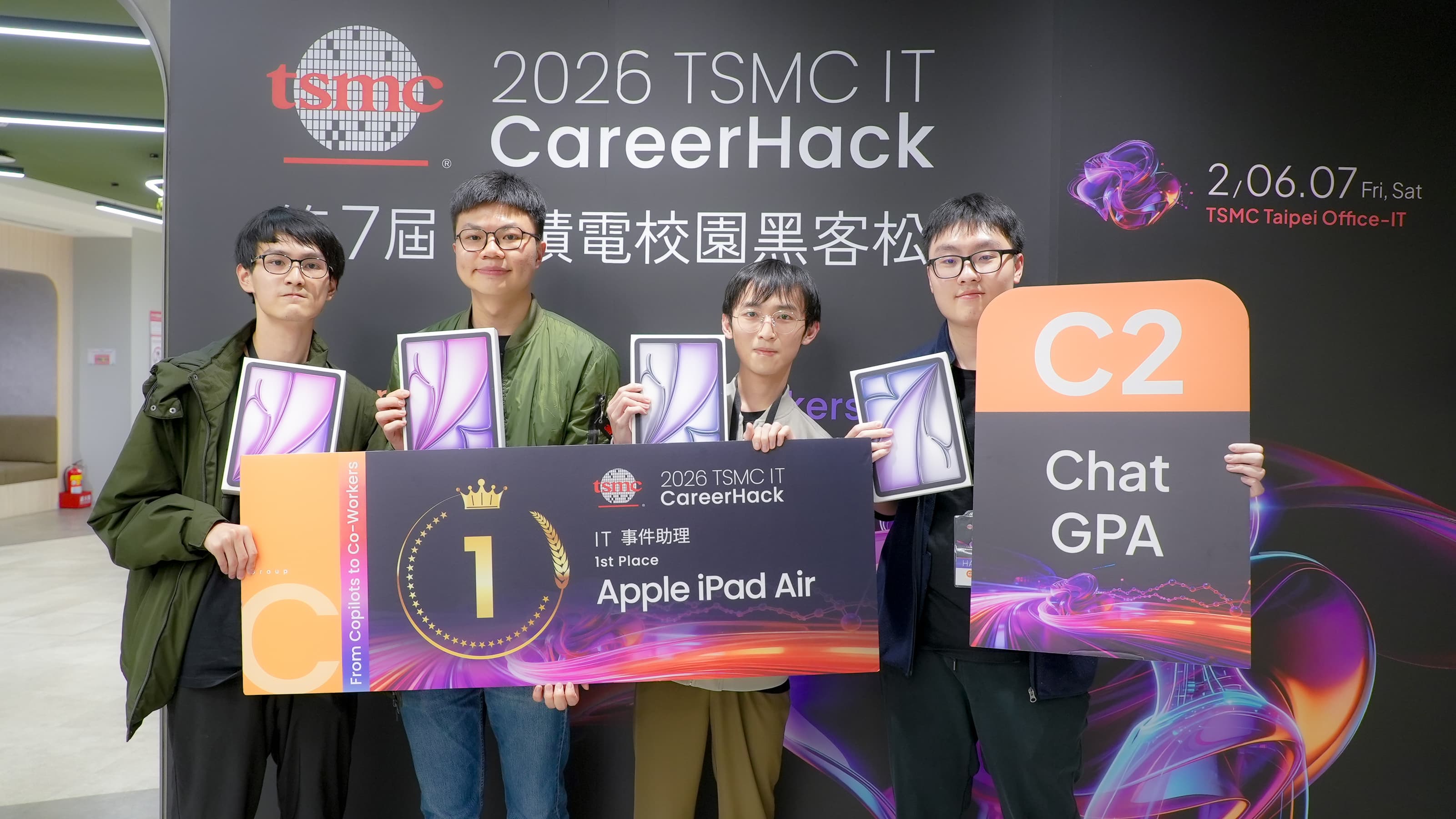
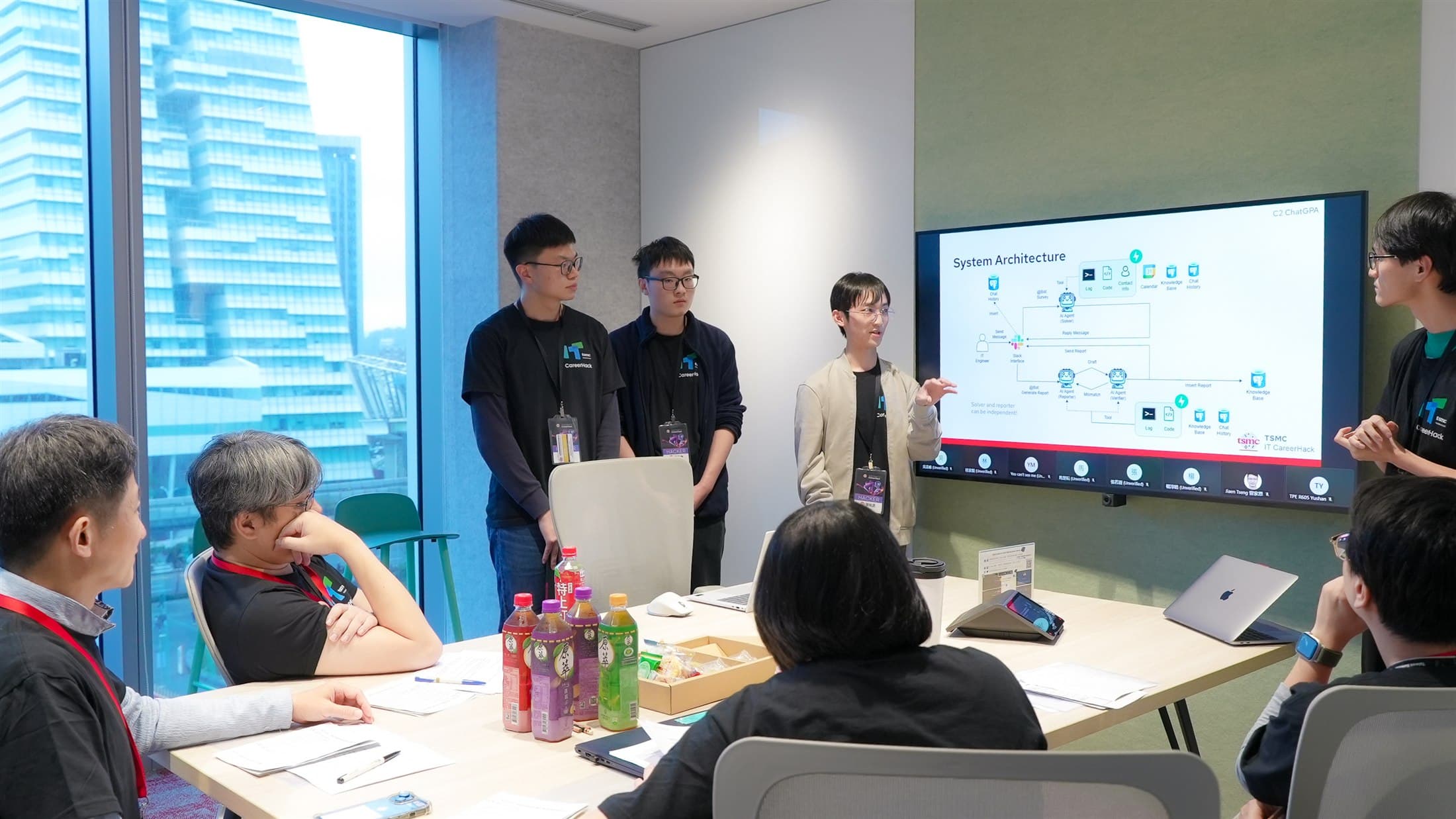
Problem
Logs, private codebases, prior incident reports, chat history, and engineers' experience rarely sit in one place. Generic web AI cannot access that context, while isolated command-line agents make collaboration and knowledge sharing difficult. The result is slower root-cause analysis and repeated post-incident administration.
Market Signals
Web-based assistants cannot reach live logs or private codebases.
CLI agents keep useful context inside individual sessions instead of the shared incident room.
Resolved cases disappear into chat history instead of improving the next investigation.
Proposed Solution
01
Retrieve relevant past cases and conversation history before an investigation begins.
02
Follow evidence across logs and code to identify likely root causes.
03
Separate report generation from source checking through a dedicated verifier.
04
Return approved resolutions to the knowledge base for future incidents.
System Architecture
The investigation, verification, and knowledge-retention loop reconstructed from the CareerHack prototype.
A shared Slack war room keeps the investigation visible to the team.
Evidence
Logs · Private codebase · Past incidents · Chat history
Reads evidence and retrieves relevant organizational context before proposing a root cause.
Structures the evidence into a formal incident report and a concise summary.
Checks every claim against source material and sends mismatches back to the Reporter.
Approved reports return to the knowledge base as retrievable context for the next incident.
My Contribution
Original Competition Slide
The original team slide shows the Slack-based agent workflow, shared evidence sources, Reporter-Verifier loop, and knowledge-base writeback used in the prototype.
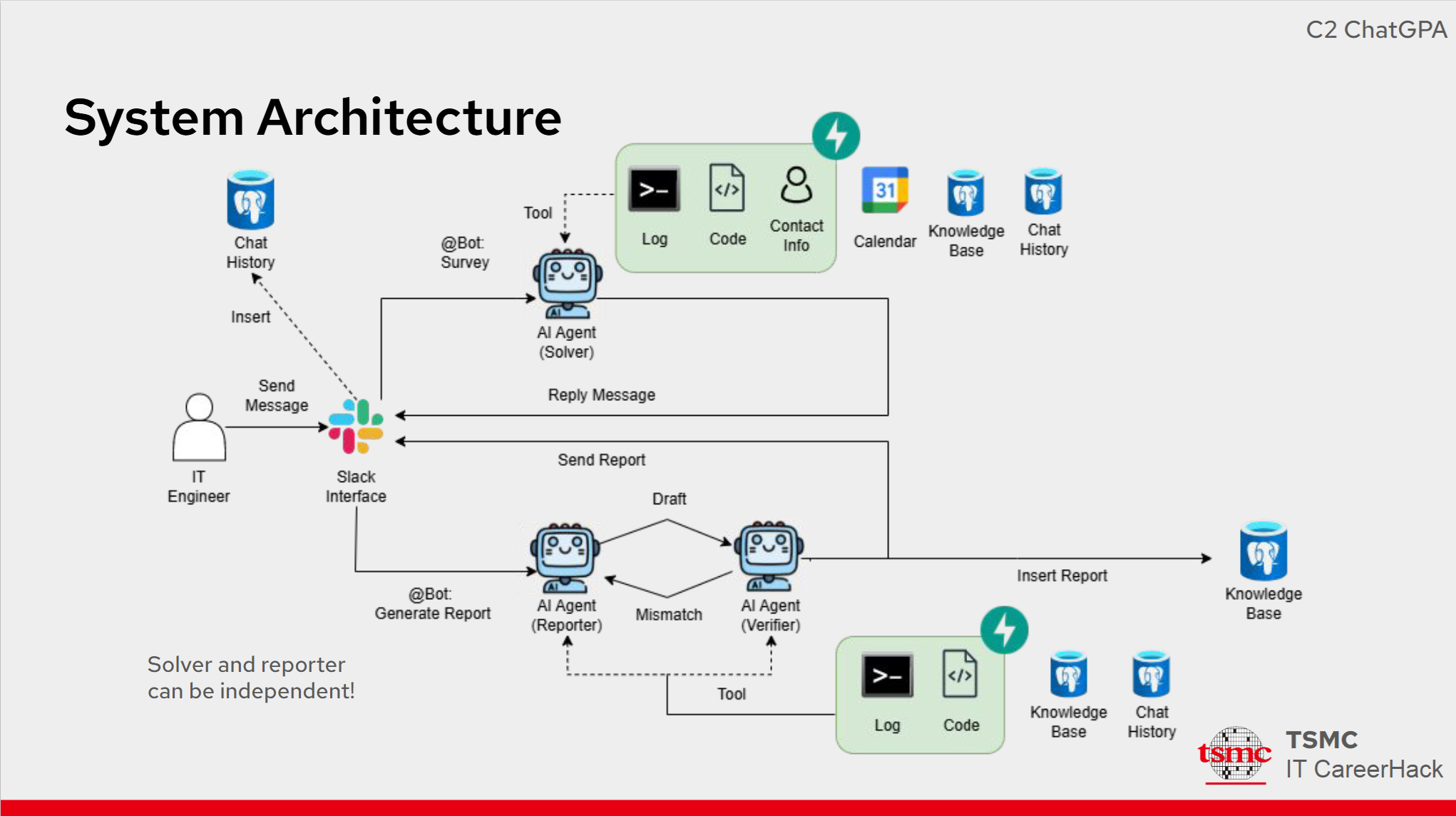 Open full-size slide
Implementation & Outcomes
The n8n-orchestrated agents plug directly into Slack, so questions, investigation progress, and results stay visible to the team.
Agents read logs and code through a FastAPI tool layer, and the Vertex AI-powered Reporter turns the findings into a formal PDF and a concise summary.
Approved reports are chunked, embedded with gemini-embedding-001, and stored in pgvector on PostgreSQL, with source-level dedup to reduce duplicate content in retrieval.
Limitations
I.R.I.S. was a hackathon prototype, so the 40% MTTR reduction is a projected business estimate rather than a production measurement. Real deployment would still require permission design for private logs and code, evaluation on representative incidents, and ongoing governance of knowledge quality.